
































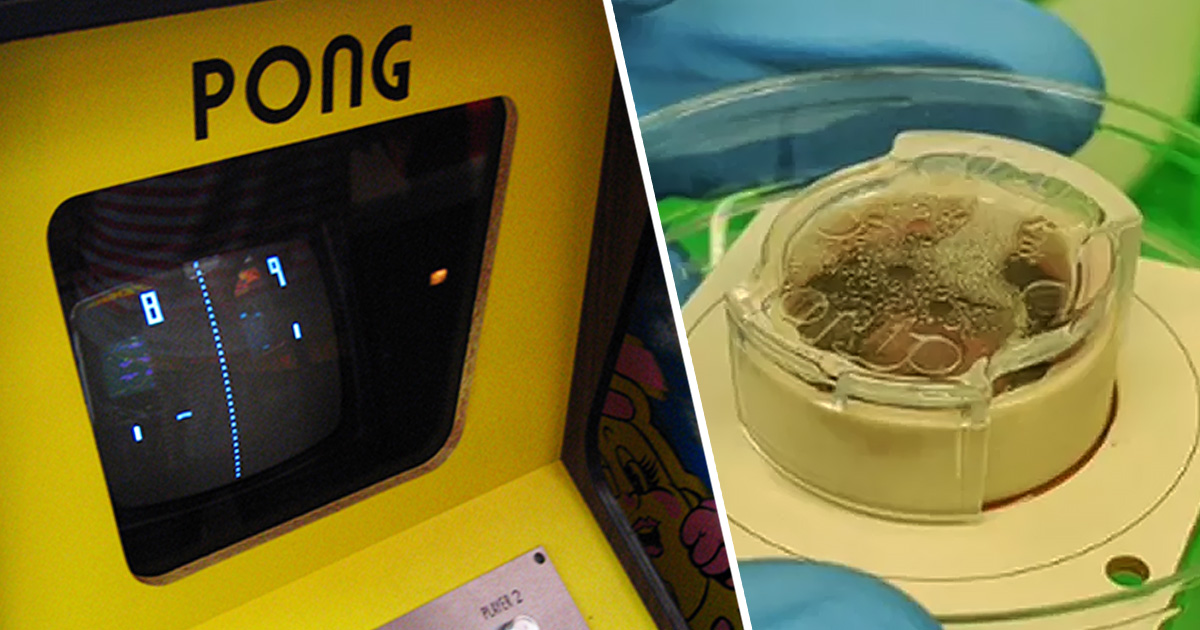

Researchers claim that a petri dish of human brain cells and embryonic rodent cells was able to quickly master Pong, the 1972 video game emulating table tennis, a new video claims.
The researchers at Cortical Labs, who call their creation DishBrain – for its residence inside a petri dish, ostensibly – and describe it as a “synthetic biological intelligence,” explain that the “embryonic rodent and human-induced pluripotent stem cells” were able to “exhibit biological intelligence” as evidenced by the vat of bio-sludge’s ability to play Pong.
Video of the creation playing the 50-year-old video game show jerky, stunted movements that do not tend to match how a human or computer program would play the game, however, it manages to predict the Pong ball’s trajectory for the entirety of the video’s 1:05 duration:
Australian neuroscientist Brett Kagan, one of the researchers behind the project, said the experiment shows “we can interact with living biological neurons in such a way that compels them to modify their activity, leading to something that resembles intelligence.”
The biological sludge used for the experiment was “extracted from embryonic mice and human neurons grown from stem cells,” explained Science Alert.
Those cells were then “grown on arrays of microelectrodes that could be activated to stimulate the neurons, thus providing sensory input,” and apparently allowing DishBrain to learn vintage video games through a software the scientists used to “deliver critique via electrodes whenever” it missed the ball.
Interestingly, the biological creation’s level of exertion declined the more it played the game, suggesting to researchers that it was able to learn and retain information about how to play Pong.

Cortical Labs
Though Kagan and other scientists have stressed the impressive nature of the experiment, he questioned whether calling the sludge “sentient” would be appropriate, according to the BBC.
“We could find no better term to describe the device,” the outlet reported. “It is able to take in information from an external source, process it and then respond to it in real time.”
The UK outlet adds that the researchers “grew” the human brain cells “from stem cells” and “from mouse embryos” until they had 800,000 cells.
The study was published on the scientific journal Neuron on October 12.