


































This analysis and commentary article originally appeared at HerculeanStrength.com
The microplastics crisis has been a regular subject of coverage here at Herculean Strength, as the devastating consequences for the environment and health become clearer.
Now scientists in China claim to have produced a robotic fish that can literally suck up microplastics from the ocean.
Microplastics: are robotic fish the solution?
The results of the Chinese scientists’ experiments are described in the journal Nano Letters.
The fish robot is just half-an-inch from end to end. The physical structure of the robot is based on the structure of mother of pearl. It is propelled by rapidly turning a near-infrared light laser on and off at the tail.
In experiments the robot moved nearly three body lengths per second, which is a new record for soft marine robots, allow it to reach the same speed as active phytoplankton. The robot repeatedly adsorbed nearby polystyrene microplastics and transported them elsewhere.
The device is also able to “heal” itself after being cut and maintain its ability to pick up debris. The scientists claim that its durability and speed make it ideal for monitoring microplastics and other pollutants in harsh aquatic environments.

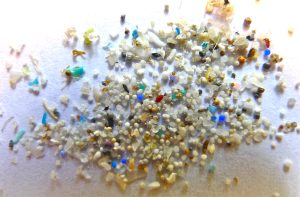
Plastic recovered from the ocean (Laura / Flickr)
“The proof-of-concept robot is demonstrated to emphasize its maximum swimming speed of 2.67 body length per second, whose speed is comparable to that of plankton, representing the outperformance of most artificial soft robots,” the authors write in their paper.
“Furthermore, the robot can stably absorb pollutants and recover its robustness and functionality even when damaged.”
Traditional materials used for soft robots are hydrogels and elastomers, which can be easily damaged in water. Mother of pearl, by contrast, which is also known as nacre, is strong and flexible. It is found on the inside of clam shells.
The scientists developed a similar structure to make the durable and bendable material for their fish. They first made nanosheets from a cocktail of chemicals including graphene, which is referred to as “the toughest material on Earth”. Solutions were incorporated with different concentrations into polyurethane latex mixtures. A layer-by-layer assembly method formed an ordered concentration gradient, just like mother-of-pearl.
“This study breaks the mutual exclusivity of functional execution and fast locomotions,” the authors write.
“We anticipate our nanostructural design will offer an effective extended path to other integrated robots that required multifunction integration.”
Oregon State University / Flickr
Microplastics: bad news for the environment and for you
In recent months, as part of our ongoing spotlight on the harmful industrial and natural chemicals that are playing havoc with our health, we’ve written about microplastics on a number of occasions.
Microplastics – tiny pieces of plastic that are either designed to be that size or become so through weathering – act as vectors for harmful xenoestrogens, as well as causing physical damage to organisms, especially microorganisms and juvenile organisms like baby fish.
The scale of the problem is already mind-boggling. Scientific models now suggest that microplastics are so ubiquitous that they are circulating like a ‘force of nature’, reaching the most remote places – even places humans have never set foot before.
In one recent study, researchers at the New York University School of Medicine compared stool samples from newborns, infants and adults to ascertain concentrations of two different kinds of plastic in them. All of the subjects were from New York State.
First of all, they noticed that all of the samples contained at least one of the two types of microplastic they were looking for. This shouldn’t be surprising, given what we already known about the ubiquity of these substances.
The real shock came when they compared the baby samples to those of the adults. In the baby samples, there were at least TEN times as much microplastic. Yes, that’s right: TEN times.
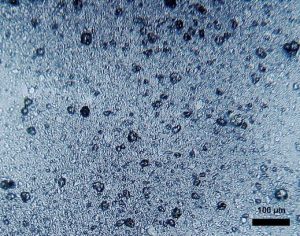
Microplastics under a microscope
So how could this be happening?
The researchers believe that the way babies are consuming such high levels of microplastics is through chew-toys like dummies and from crawling around on carpets that contain microplastics.
It’s worth noting, too, that microplastics have already been found in the placentas of mothers, raising the prospect that some of the microplastics found in the babies in the sample could have been passed to them by their mothers.
Although scientists once believed microplastics would just pass through the gastrointestinal tract without causing any harm, recent research suggests the smallest pieces are able to cross cell membranes and enter our circulation.
This is an obvious cause for concern, and all the more so because research on microplastics in lab animals has caused cell death, inflammation and metabolic disorders.
Human research is also beginning to substantiate these potential harms. A new study has shown, for instance, that microplastics can alter the shape of human lung cells and affect their functioning.