















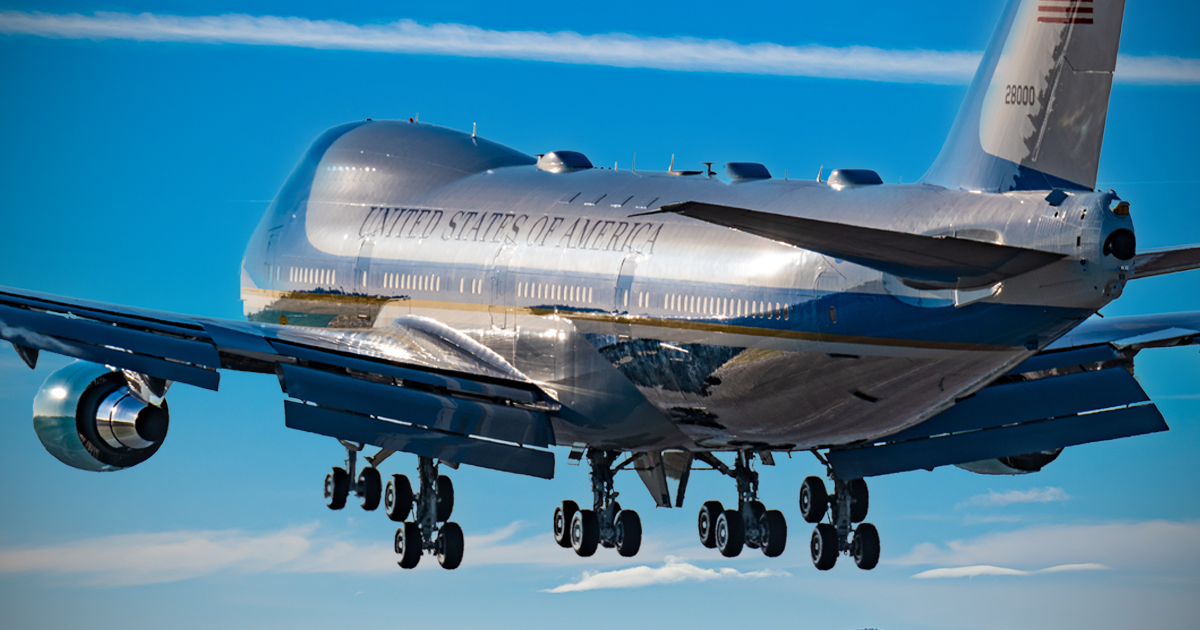

Boeing is facing more bad publicity over its production of two new planes to be used by the President of the United States, with the latest blunder happening less than a year after empty tequila bottles were found on board one of the new planes.
According to Manufacturing.net, “one of Boeing’s two next generation Air Force Ones could have been damaged” when workers attempted to “shift the under-construction jet onto jacks.”
Apparently the weight of the beefed up airplane – Air Force One is required to have advanced shielding to protect from physical attacks as well as electromagnetic pulse attacks – was too much for the jacks.
“The Air Force did not find any damage,” the website reports, but after investigating they learned “that Boeing crews didn’t follow established procedure” and apparently “one employee wasn’t properly credentialed to supervise the work.” Another employee failed a routine drug test.
Boeing, which is already “months behind schedule” in its task to create the new presidential jets, was chastised by the Air Force to “improve its operations” and a Boeing spokeswoman apparently told the Wall Street Journal that corrective actions were being taken by the multinational defense contractor.
Aside from the high profile crash of a Boeing jet in China last month, the company faced harsh headlines over its new Air Force One jets last year, when tequila bottles were discovered abandoned in the one of the partially finished planes.
On September 18 of last year, the Wall Street Journal reported that “two empty liquor bottles were found” on one of the planes, and the outlet later specified that they were tequila.
However, “It couldn’t be determined where on the plane the bottles were discovered.”
The website explained at the time that “this incident is particularly serious because it involves alcohol and a highly classified jet” to eventually be tasked with transporting the President of the United States.
Boeing received $3.9 billion from the Trump administration to make the new planes in 2018, though they “signaled” they may request an additional sum, potentially “more than $500 million,” from the government due to COVID-19 and supply chain issues.