


























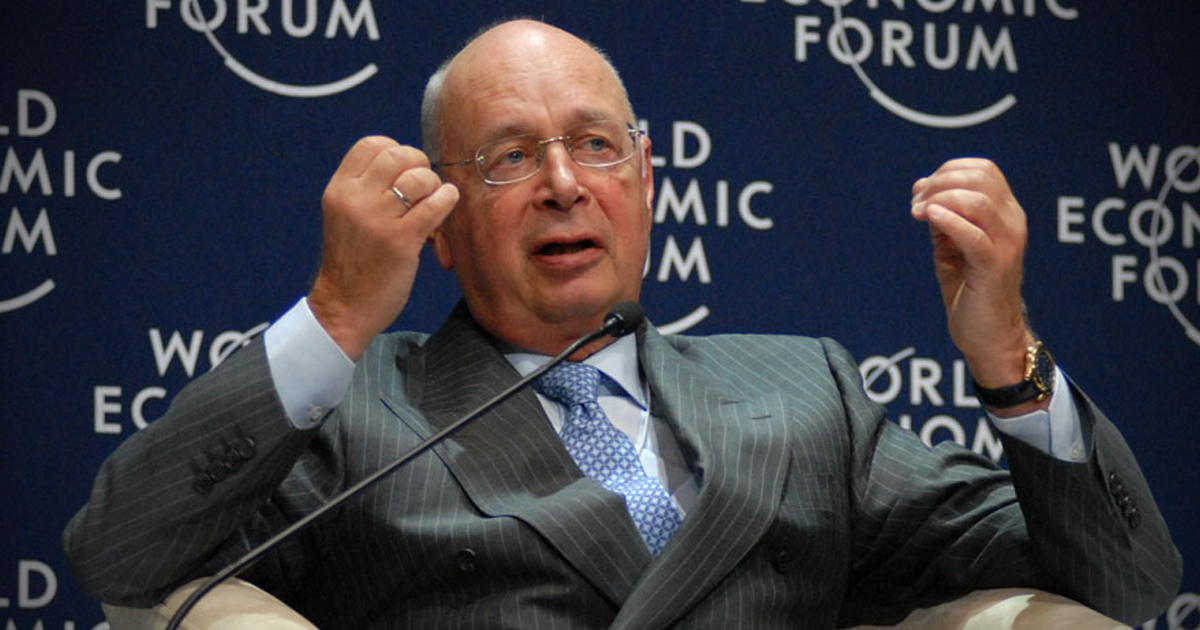

The World Economic Forum, a controversial international organization headed by billionaire Klaus Schwab, is now saying that “life doesn’t have to be happy, or even meaningful” to be good.
Rather than having a happy and meaningful life, the WEF believes that individuals could have a good life through “psychological enrichment” instead.
“A psychologically rich life is one characterized by ‘interesting experiences in which novelty and/or complexity are accompanied by profound changes in perspective’,” wrote the WEF.
“What does a good life look like to you? For some, the phrase may conjure up images of a close-knit family, a steady job, and a Victorian house at the end of a street arched with oak trees. Others may focus on the goal of making a difference in the world, whether by working as a nurse or teacher, volunteering, or pouring their energy into environmental activism,” the organization wrote.

Klaus Schwab and President George W. Bush in 2008 (World Economic Forum / Flickr)
Rather than living a “hedonic” life, “one based on pleasure, comfort, stability, and strong social relationships,” or a “eudaimonic” life, describing the “sense of purpose and fulfillment one gets by contributing to the greater good,” the WEF is instead endorsing a life that is “psychologically rich.”
“Crucially, an experience doesn’t have to be fun in order to qualify as psychologically enriching. It might even be a hardship. Living through war or a natural disaster might make it hard to feel as though you’re living a particularly happy or purposeful life, but you can still come out of the experience with psychological richness,” wrote the WEF.
“Or you might encounter less dramatic but nonetheless painful events: infertility, chronic illness, unemployment. Regardless of the specifics, you may experience suffering but still find value in how your experience shapes your understanding of yourself and the world around you,” the organization continued.
According to the WEF, who referenced a psychological study by American Psychological Association’s Psychological Review, living a “psychologically rich” life with hardships was “important because it ‘makes room for challenge and difficulty. It’s not just about ‘everything going well and smoothly.’”
The organization added that humans should “allow ourselves only narrow models of what a good life can be,” so as to not be “presumptive and dismissive of people’s experiences and values.”
The WEF came under fire for similar messaging in 2020 when they declared in a now-deleted Twitter video that by the year 2030 “you’ll own nothing. And you will be happy.”
“Whatever you want you’ll rent and it’ll be delivered by drone,” the WEF stated, adding that the “US won’t be the world’s leading superpower. A handful of countries will dominate.”
“You won’t die waiting for an organ donor. We won’t transplant organs. We’ll print new ones instead,” the WEF said.
“You’ll eat much less meat. An occasional treat, not a staple. For the good of the environment and our health.